
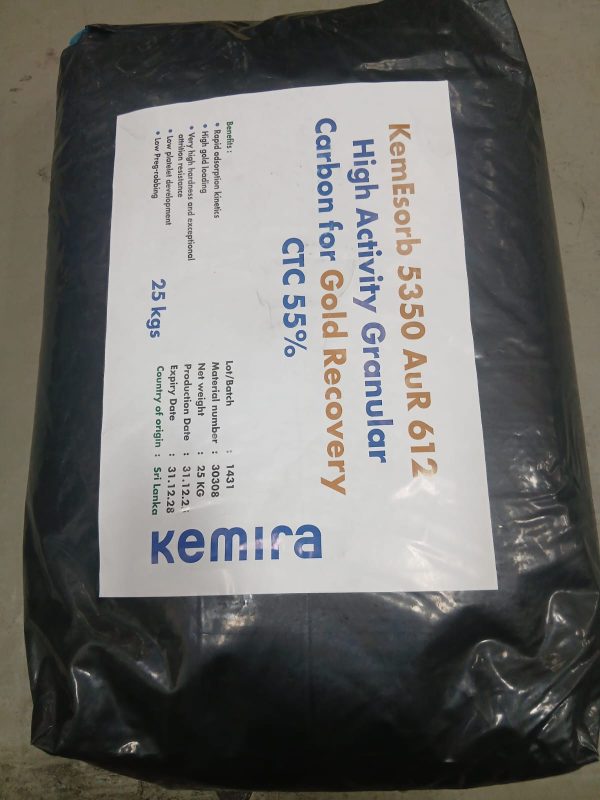
Granular Activated Carbon for Gold Recovery – Kenya, Uganda, Tanzania & Ethiopia
Product Description
Granular Activated Carbon for Gold Recovery is a specialised carbon material used in gold-processing operations to adsorb dissolved gold complexes from suitable process solutions. It has a porous structure and a large internal surface area, which allows it to capture gold-bearing species under appropriate operating conditions. Gold-processing plants commonly apply activated carbon in cyanide-based extraction circuits, where dissolved gold forms a gold-cyanide complex.
The carbon quality plays an important role in gold recovery. Important characteristics include adsorption activity, hardness, particle-size distribution, pore structure, and resistance to abrasion. High-quality carbon for gold processing should maintain its physical strength during agitation and screening, helping minimise carbon losses and the formation of fine particles. The correct specification depends on the extraction method, plant design, operating conditions, and recovery targets.
Granular Activated Carbon may be applied in Carbon-in-Pulp (CIP), Carbon-in-Leach (CIL), and Carbon-in-Column (CIC) systems. In CIP operations, the carbon adsorbs dissolved gold from a slurry after the leaching stage. In CIL systems, leaching and adsorption take place together in tanks. In CIC systems, carbon treats suitable gold-bearing solutions as they pass through columns. Each method requires carbon with suitable particle size, activity, and mechanical strength.
System Star Industrial supplies industrial chemicals and raw materials to businesses across Kenya, Uganda, Tanzania, and Ethiopia. We support mining operations, mineral-processing facilities, and commercial customers seeking materials for gold-recovery processes. Contact our team to confirm available carbon grades, particle sizes, packaging, technical specifications, and current stock.
Granular Activated Carbon for gold recovery must meet the operating requirements of the processing plant. Before purchasing, check the carbon’s gold adsorption performance, hardness, abrasion resistance, particle size, moisture content, and ash content. The supplier’s technical data sheet and trial testing can help confirm suitability for the intended circuit.
Applications of Granular Activated Carbon for Gold Recovery
Carbon-in-Pulp (CIP): Adsorbs dissolved gold complexes from leached ore slurry in gold-processing plants.
Carbon-in-Leach (CIL): Supports gold adsorption while leaching takes place in the same processing tanks.
Carbon-in-Column (CIC): Captures dissolved gold from suitable gold-bearing solutions flowing through carbon columns.
Gold extraction plants: Supports gold recovery circuits that rely on activated carbon adsorption.
Mineral processing: Serves as an adsorption medium in suitable hydrometallurgical operations.
Gold adsorption circuits: Helps transfer dissolved gold from process solution onto carbon for subsequent recovery and processing.
Mining operations: Supports commercial gold-recovery systems when the carbon grade matches the plant’s operating conditions.
Key Features & Benefits
| Feature | Benefit |
|---|---|
| Porous carbon structure | Provides internal surface area for adsorption |
| High adsorption activity | Supports capture of dissolved gold complexes |
| Suitable granular particle size | Helps support carbon retention and screening in compatible circuits |
| Mechanical strength | Helps reduce breakage and carbon losses during processing |
| Abrasion resistance | Supports performance in systems involving agitation and movement |
| Application-specific grades | Allows selection according to plant design and process requirements |
| Reusable within suitable circuits | Carbon may undergo stripping and regeneration as part of an established recovery process |
Technical Data Sheet of Granular Activated Carbon for Gold Recovery
| Parameter | Typical Specification |
|---|---|
| Product name | Granular Activated Carbon for Gold Recovery |
| Material | Activated carbon |
| Common raw materials | Coconut shell, coal, or other suitable carbon sources, depending on grade |
| Appearance | Black granules |
| Main function | Adsorption of dissolved gold complexes |
| Main applications | CIP, CIL, and CIC gold-recovery circuits |
| Particle size | Depends on the selected grade and processing system |
| Iodine number | Grade-dependent; not sufficient on its own to establish gold-recovery performance |
| Gold adsorption activity | Must be confirmed using the supplier’s relevant test data |
| Hardness | Grade-dependent; confirm the specified test method and result |
| Abrasion resistance | Grade-dependent |
| Ash content | Depends on raw material and manufacturing process |
| Moisture content | Depends on grade and packaging |
| Bulk density | Depends on raw material and particle size |
| Packaging | Subject to availability and order requirements |
| Storage | Keep dry and protected from contamination in suitable packaging |
Note: No single technical specification suits every gold-recovery plant. Confirm particle size, adsorption activity, hardness, abrasion resistance, ash content, moisture, and other critical parameters against the manufacturer’s technical data sheet. Conduct suitable process testing before adopting a new carbon grade.
Why Choose System Star Industrial?
- Supply options for industrial materials and chemical raw materials.
- Support for mining and mineral-processing enquiries.
- Supply coverage across Kenya, Uganda, Tanzania, and Ethiopia.
- Assistance with product specifications and grade selection enquiries.
- Support for commercial and bulk quantity requirements.
- A diverse product range for industrial and manufacturing sectors.
- Professional quotation and order support.
FAQs about Granular Activated Carbon for Gold Recovery
Q1: What is Granular Activated Carbon for gold recovery?
It is a porous carbon material that adsorbs dissolved gold complexes from suitable process solutions in gold-extraction operations.
Q2: What is the difference between CIP and CIL?
In Carbon-in-Pulp (CIP), leaching generally takes place before the slurry enters the carbon adsorption circuit. In Carbon-in-Leach (CIL), leaching and adsorption occur together in the same tanks.
Q3: Can granular activated carbon work in a Carbon-in-Column system?
Yes. A suitable carbon grade can adsorb gold from appropriate gold-bearing solutions in Carbon-in-Column systems. The particle size and hydraulic properties must suit the column design.
Q4: Does every activated carbon grade suit gold recovery?
No. General-purpose activated carbon may not meet the activity, hardness, particle-size, and abrasion requirements of gold-processing circuits. Choose a grade specifically evaluated for gold recovery.
Q5: Which specifications should buyers check?
Check particle-size distribution, gold adsorption performance, hardness, abrasion resistance, ash content, moisture, and bulk density. The importance of each parameter depends on the plant design and operating conditions.
Q6: Can activated carbon be reused?
In suitable gold-recovery circuits, carbon can undergo gold stripping and, where appropriate, regeneration before returning to service. The process requires specialised equipment and operating controls.
Q7: Can System Star Industrial supply granular carbon in bulk?
Contact our team to confirm available grades, packaging, order quantities, technical specifications, pricing, and delivery arrangements.
Q8: How should granular activated carbon be stored?
Keep it dry and protected from dust, oil, chemicals, and other contaminants. Store it in suitable packaging and follow the manufacturer’s handling instructions. Avoid creating carbon dust and keep the material away from ignition sources.
Contact Us
For quotations and orders in Kenya, Uganda, Tanzania, and Ethiopia, contact System Star Industrial.
Phone: 0723 137 378 / 0736 395 602
Email: [email protected]
Website: www.systemstarindustrial.com
Contact our team for available grades, particle sizes, technical specifications, packaging options, bulk quantities, and delivery arrangements.
Reviews
There are no reviews yet.